
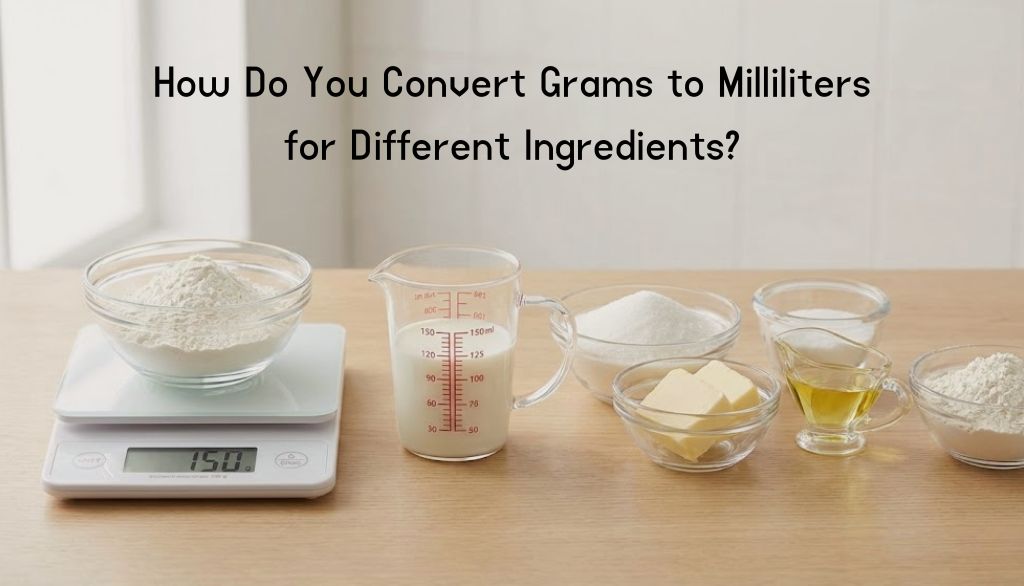
Recipes fail when measurements confuse you. Grams measure weight. Milliliters measure volume. Ingredients change density. Online unit converters ignore this fact. That gap creates wrong textures, dry dough, or runny batters. This guide fixes that problem with ingredient-specific logic, real examples, and clear conversions.
Why Does Converting Grams to Milliliters Cause Confusion?
Grams do not convert directly to milliliters without density. Density defines how much space one gram occupies. Water has a density of 1 g/ml. Flour does not. Sugar does not. Oil does not.
Most competitors:
- Treat all ingredients like water
- Show a single calculator without context
- Skip real cooking examples
- Ignore packing, grind size, and temperature
You need ingredient-based conversion, not a generic tool. Next, you will see how density controls every conversion.
What Is the Formula to Convert Grams to Milliliters?
Milliliters equal grams divided by density.
Formula: ml = g ÷ density (g/ml)
Density varies by ingredient and form. Fine flour differs from coarse flour. Melted butter differs from solid butter. This is where most content stays shallow. Below, you see practical ingredient data with real use cases.
How Do You Convert Grams to Milliliters for Water?
Water converts at a 1:1 ratio. 100 grams of water equals 100 milliliters. This works because water’s density equals 1 g/ml at room temperature. Many recipes silently assume this rule applies everywhere. That assumption breaks baking accuracy. Now compare water with dry ingredients.
How Do You Convert Grams to Milliliters for Flour?
Flour does not convert from grams to ML at a fixed ratio. All-purpose flour has an average density of 0.53 g/ml when spooned, not packed. This density value is the key input any accurate grams to ml converter must use.
Example:
100 grams flour ÷ 0.53 = 188 milliliters flour
If you compress flour into the cup, density increases and volume decreases. Many g to ml tools ignore this variable, which explains inconsistent baking results. Reliable grams to milliliters conversions always assume spooned flour unless stated otherwise. Next, sugar follows a different density pattern and conversion logic.
How Do You Convert Grams to Milliliters for Sugar?
Granulated sugar has higher density than flour. Granulated sugar averages 0.85 g/ml.
Example:
- 100 grams sugar ÷ 0.85 = 118 ml sugar
Powdered sugar changes density again due to air pockets. That difference explains why frosting often fails when volume cups replace weight.
Next, fats behave differently again.
How Do You Convert Grams to Milliliters for Butter and Oil?
Fats depend on state and type.
Butter:
- Melted butter density: 0.91 g/ml
- 100 grams melted butter = 110 ml
Oil:
- Vegetable oil density: 0.92 g/ml
- 100 grams oil = 109 ml
Solid butter measures differently because trapped air increases volume. Competitors usually skip this distinction. Next, common cooking liquids.
How Do You Convert Grams to Milliliters for Milk and Cream?
Milk stays close to water but not equal.
- Whole milk density: 1.03 g/ml
- 100 grams milk = 97 ml
Heavy cream:
- Density: 0.99 g/ml
- 100 grams cream = 101 ml
Small differences matter in custards, sauces, and dough hydration. Now you will see a quick reference that avoids calculator errors.
Common Grams to Milliliters Conversions by Ingredient
| Ingredient | Density (g/ml) | 100 g in ml |
| Water | 1.00 | 100 ml |
| All-purpose flour | 0.53 | 188 ml |
| Granulated sugar | 0.85 | 118 ml |
| Butter (melted) | 0.91 | 110 ml |
| Vegetable oil | 0.92 | 109 ml |
| Whole milk | 1.03 | 97 ml |
These values reflect average kitchen conditions. Professional kitchens still prefer scales because density shifts with humidity and handling. Next, you will understand when calculators fail.
Why Grams to Milliliters Calculators Give Wrong Results
Most calculators assume water density. That shortcut inflates flour volume and shrinks sugar volume. The error compounds in baking.
Missing factors include:
- Ingredient type
- Particle size
- Packing method
- Temperature
A correct calculator must ask for the ingredient first. If it does not, accuracy drops immediately. Next, you will learn the safest method for recipes.
Should You Use Grams or Milliliters in Recipes?
Grams give higher accuracy than milliliters.
Professional recipes use grams for dry and liquid ingredients. Volume works for water-based liquids only.
If a recipe gives milliliters for flour, convert using density or switch to weight. This avoids texture failure and ingredient waste.
Next, a real baking example shows why this matters.
Real Example: Cake Recipe Failure Explained
A recipe asks for:
- 200 ml flour
If you assume water density, you add 200 grams of flour.
Correct conversion:
- 200 ml × 0.53 = 106 grams flour
That error almost doubles flour content. The cake turns dry and dense. This mistake appears daily in user comments across food blogs. Most competitors never explain why.
Next, you will know how to convert safely every time.
How Do You Convert Grams to Milliliters Correctly Every Time?
Identify the ingredient, then apply its density. Do not rely on generic charts. Use ingredient-specific data. Weigh dry ingredients when possible. Convert only when required by the recipe. This approach removes guesswork and fixes the measurement confusion users search for.