
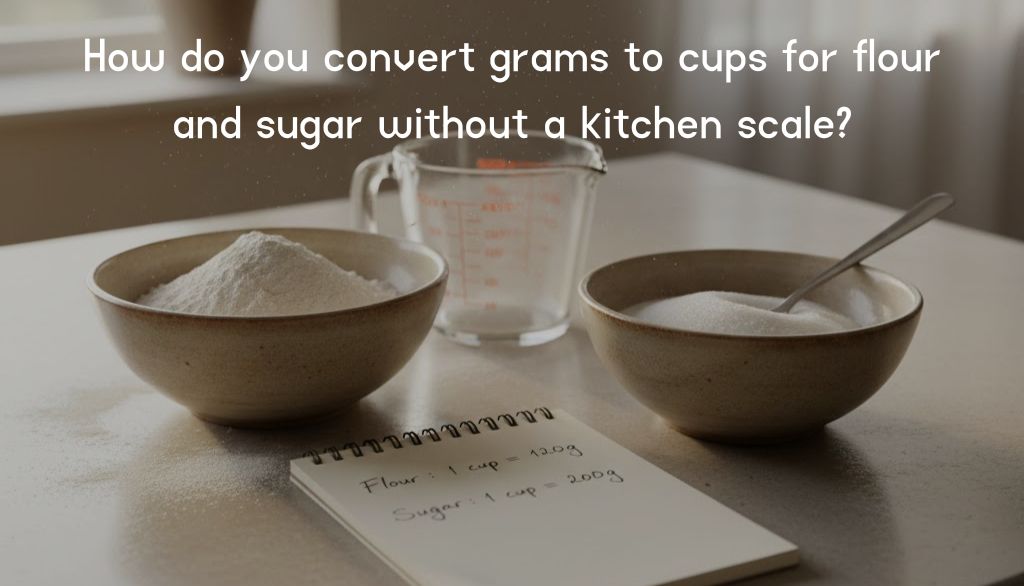
You follow the recipe. You bake the cake. You cut a slice. The crumb feels tight. The bite feels dry. You blame the oven. You blame the recipe. Most of the time, flour caused the problem.
A “cup” of flour can swing a lot. A packed cup can reach 160g, but a light spoon-and-level cup can sit near 120g. That gap can wreck a cake ratio. So, in thi article Rose Converter will guide you how do you convert cups to grams fast, and still keep the cake soft?
Why does flour measured in cups dry out cake?
Cake needs balance. Flour sets structure. Sugar holds moisture. Fat adds tenderness. Eggs bind. Leaveners lift. Extra flour shifts the balance. You get:
- Less free moisture per gram of flour
- More gluten potential
- A tighter crumb
- A drier mouthfeel
A simple scoop from the bag packs flour. King Arthur Baking notes a condensed cup can reach 160g, versus about 120g using a fluff, scoop, and level approach.
You can fix most “dry cake” cases by fixing flour measurement first.
Which “cup” does your recipe use?
Recipe writers do not all use the same cup system.
- US customary cup often maps to 236.588 mL in conversion references.
- Metric cup equals 250 mL in many countries.
- Nutrition labels often use household measure guidance tied to metric declarations.
You can spot the cup type fast.
- A US blog recipe usually means US cups.
- An AU/NZ recipe often means metric cups.
- A recipe that lists grams also signals the author cares about weight more than volume.
What grams-per-cup values work for flour and sugar?
You need a reference chart. You also need consistency. King Arthur Baking lists common baking weights per cup:
- All-purpose flour: 1 cup = 120g
- Granulated white sugar: 1 cup = 198g
- Brown sugar, packed: 1 cup = 213g
- Confectioners’ sugar (unsifted): 1 cup = 113g
Use one chart per kitchen. Stick to it for that recipe set. Cake results improve fast.
How do you convert cups to grams for flour and sugar?
You only need one rule.
Grams = cups × grams-per-cup
Example values (US cups):
- Flour grams = cups × 120
- Granulated sugar grams = cups × 198
Quick examples:
- 1.5 cups all-purpose flour → 1.5 × 120 = 180g
- 3/4 cup granulated sugar → 0.75 × 198 = 148.5g (round to 149g)
You can treat that as your “grams to cups converter” logic too. You just flip the math.
How do you convert grams to cups without a scale?
You can use the reverse rule.
Cups = grams ÷ grams-per-cup
Use it as a grams to cups converter on paper.
- Flour cups = grams ÷ 120
- Sugar cups = grams ÷ 198
You can also convert cups to spoons:
- 1 cup = 16 tablespoons
- 1 tablespoon = 3 teaspoons
That spoon step saves you when you land on odd decimals.
How much is 130 grams in cups?
People search “how much is 130 grams in cups” because recipes jump between systems. Results depend on the ingredient.
How much is 130 grams of flour in cups?
All-purpose flour uses 120g per cup in the chart.
Cups = 130 ÷ 120 = 1.08 cups
Kitchen-friendly measure:
- 1 cup + 1 tablespoon + 1 teaspoon (approx.)
That small “extra” matters in cake.
How much is 130 grams of granulated sugar in cups?
Granulated sugar uses 198g per cup in the chart.
Cups = 130 ÷ 198 = 0.66 cups
Kitchen-friendly measure:
- About 2/3 cup, then remove about 1 teaspoon for a closer match.
How much is 130 grams of water in cups?
Many people also search for grams to cups of water.
Two realities exist:
- US cup volume often maps to 236.588 mL in conversion references.
- Water density near room temp sits close to 0.997–0.998 g/mL.
A practical kitchen result:
- 1 US cup water ≈ 236g (room temp)
So:
- Cups = 130 ÷ 236 ≈ 0.55 cups
- Measure: 1/2 cup + 2 1/2 teaspoons (approx.)
You may also see 1 cup water = 227g in baking charts, because 8 oz by weight equals 227g. King Arthur’s chart lists water 1 cup = 227g.
Pick one system per recipe. Stay consistent.
How do you measure flour in a cup so it matches grams?
You can get close to “scale accuracy” without a scale, but you must use the right method.
Use the spoon-and-level method:
- Fluff flour in the bag or jar.
- Spoon flour into a dry measuring cup.
- Level the top with a straight edge.
- Do not tap the cup.
- Do not press flour down.
Allrecipes warns against scooping straight from the bag because it packs flour and causes dry results.
Martha Stewart also describes the fluff and level approach as the “right way” for volume flour.
You want the cup to act like a “loose fill,” not a “packed fill.”
How do you measure sugar in cups the right way?
Sugar behaves differently than flour.
Granulated sugar
Granulated sugar settles more evenly than flour. You can pour, then level. A cup weight reference still helps because brands vary. King Arthur lists 198g per cup for granulated white sugar.
Brown sugar
Recipes often say “packed.” You should press it into the cup, then level. King Arthur lists 213g per packed cup
Powdered sugar
Powdered sugar traps air. Sifting changes volume. King Arthur lists 113g per cup (unsifted).
Ask one question before you measure: “Does the recipe say packed or sifted?” That one word changes everything.
What quick conversion table helps during baking?
Use US cup values from the same chart.
| Cup Measure | All-Purpose Flour (g) | Granulated Sugar (g) |
| 1/4 cup | 30g | 50g |
| 1/3 cup | 40g | 66g |
| 1/2 cup | 60g | 99g |
| 2/3 cup | 80g | 132g |
| 3/4 cup | 90g | 149g |
| 1 cup | 120g | 198g |
Use rounding for speed. Keep rounding consistent inside one recipe.
Which mistakes push flour too high?
Dry cake usually comes from one of these:
- You scoop flour straight from the bag
- You shake or tap the cup after filling
- You pack flour like brown sugar
- You use a mug, not a measuring cup
- You swap flour types without thought (cake flour vs bread flour)
- You overbake, even by 5 minutes
You can test your own habit. Fill a cup your normal way. Then refill using spoon-and-level. King Arthur Baking explains how big the swing can get.
How can you keep your bake setup consistent at home?
Counter space affects measuring accuracy. Crowded space leads to spills and rushed leveling. You can measure your prep counter area and plan a clear “bake zone.” A simple area check helps when you add a rolling mat or a large sheet pan.
You can use the Square Feet Calculator on the home page to get the counter or table area in square feet, then pick a mat size that fits your space.
FAQ people also type
“Grams to cups converter” gives different answers. Why?
Ingredient density changes volume. Flour packs. Powdered sugar traps air. Brown sugar packs by design. Charts also differ by testing method. King Arthur shows clear per-cup weights, but it also warns small differences can appear due to rounding.
“Grams into cups calculator” for flour feels wrong. What should you trust?
Trust the method first. Spoon-and-level gets you closer to the chart weight. Scooping gives you more flour than you think.
“Grams to cups of water” should be exact. Why does it vary?
Cup standards vary. Water density shifts with temperature. Room temp water sits near 0.997–0.998 g/mL.