
Use the cubic yard calculator above to find your cubic yardage in seconds. Enter length, width, and depth — the tool handles the math and shows your result in cubic yards, cubic feet, and cubic meters automatically.
Cubic Yard Calculator
Volume calculator for concrete, soil, mulch, gravel & more
Shape
Dimensions
Section B
Material type
Price estimate (optional)
What Is a Cubic Yard Calculator?
A cubic yard calculator is a free online tool that helps you quickly determine the volume of a space or material in cubic yards. Whether you’re working on a landscaping project, pouring concrete, filling a raised garden bed, or ordering mulch and gravel. This calculator takes the guesswork out of your measurements.
Simply enter the length, width, and depth of the area in feet or inches. And the calculator instantly converts those dimensions into cubic yards. That saving you time, money, and the hassle of manual math errors.
What is a Cubic Yard?
A cubic yard is a unit of measurement used to calculate volume. It equals a cube that is 3 feet long, 3 feet wide, and 3 feet tall. Which means one cubic yard contains exactly 27 cubic feet.
People commonly use cubic yards when buying or estimating bulk materials like soil, mulch, gravel, sand, and concrete. For example, if you are filling a garden bed or pouring a concrete slab, suppliers will ask you how many cubic yards you need. Understanding yards cube makes it easier to order the right amount of material, avoid waste, and save money on your project.
The Formula Behind the Cubic Yard Calculator
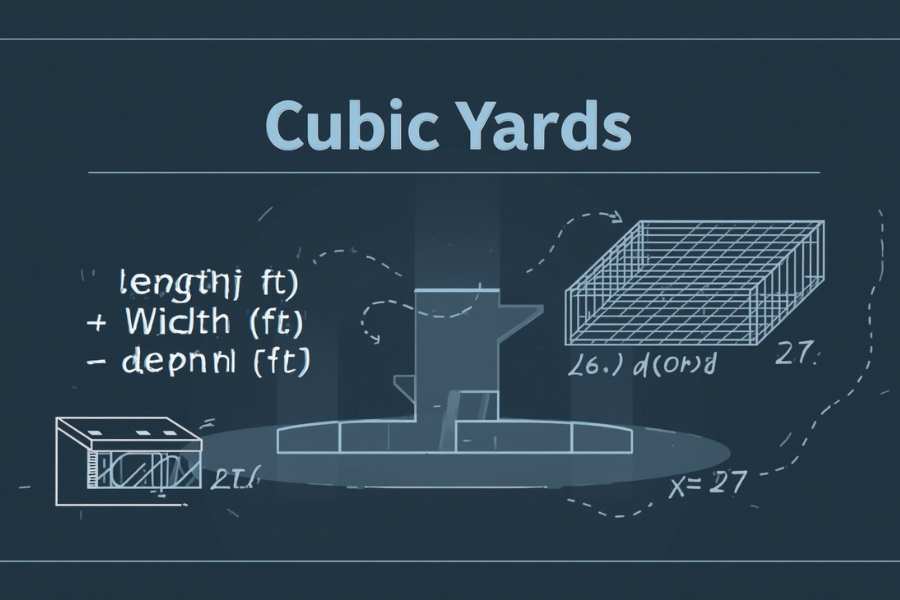
Cubic Yards = Length (ft) × Width (ft) × Depth (ft) ÷ 27
All three numbers go in as feet. The part that trips most people up is depth — it is almost always measured in inches on the job but needs to be in feet for the formula to work.
Divide your inch measurement by 12 before plugging it in:
- 2 inches → 0.167 ft
- 3 inches → 0.25 ft
- 4 inches → 0.333 ft
- 6 inches → 0.5 ft
- 12 inches → 1.0 ft
The calculator does this conversion for you. Just select your depth unit separately and enter the number as-is.
Worked Examples for Common Projects
Concrete patio slab — 15 ft × 10 ft × 4 inches thick
- Depth in feet: 4 ÷ 12 = 0.333
- Cubic feet: 15 × 10 × 0.333 = 49.95
- Cubic yards: 49.95 ÷ 27 = 1.85 yd³ → order 2 yards
Garden bed topsoil — 12 ft × 6 ft × 4 inches deep
- Depth in feet: 4 ÷ 12 = 0.333
- Cubic feet: 12 × 6 × 0.333 = 24
- Cubic yards: 24 ÷ 27 = 0.89 yd³ → order 1 yard
Circular mulch bed — 10 ft diameter × 3 inches deep
- Area: π × (5)² = 78.54 sq ft
- Cubic feet: 78.54 × 0.25 = 19.63
- Cubic yards: 19.63 ÷ 27 = 0.73 yd³ → order 1 yard
L-shaped gravel base — Section A: 12×8 ft, Section B: 6×4 ft, depth 4 inches
- Section A cubic feet: 12 × 8 × 0.333 = 31.97
- Section B cubic feet: 6 × 4 × 0.333 = 7.99
- Total: 39.96 ÷ 27 = 1.48 yd³ → add 15% compaction = order 1.75 yards
Formulas for Every Shape
Rectangle or Square Area = Length × Width → Volume = Area × Depth → ÷ 27
Circle Area = π × (Diameter ÷ 2)² → Volume = Area × Depth → ÷ 27
Triangle Area = 0.5 × Base × Height → Volume = Area × Depth → ÷ 27
L-Shape or Irregular Area Split into two rectangles. Calculate each volume separately. Add them together. Divide total cubic feet by 27.
Coverage Per Cubic Yard by Depth
One cubic yard covers different amounts of ground depending on how thick you spread it. This table shows coverage for the most common material depths used in landscaping and construction.
| Depth | Coverage Area |
| 1 inch | 324 sq ft |
| 2 inches | 162 sq ft |
| 3 inches | 108 sq ft |
| 4 inches | 81 sq ft |
| 6 inches | 54 sq ft |
| 12 inches | 27 sq ft |
Formula: Coverage (sq ft) = 324 ÷ Depth in inches
Square Feet to Cubic Yards — Reference Table
Already know your square footage? Use this shortcut:
(Square Feet × Depth in Inches) ÷ 324 = Cubic Yards
| Area | 2″ deep | 3″ deep | 4″ deep | 6″ deep |
| 100 sq ft | 0.62 yd³ | 0.93 yd³ | 1.23 yd³ | 1.85 yd³ |
| 200 sq ft | 1.23 yd³ | 1.85 yd³ | 2.47 yd³ | 3.70 yd³ |
| 300 sq ft | 1.85 yd³ | 2.78 yd³ | 3.70 yd³ | 5.56 yd³ |
| 500 sq ft | 3.09 yd³ | 4.63 yd³ | 6.17 yd³ | 9.26 yd³ |
| 1,000 sq ft | 6.17 yd³ | 9.26 yd³ | 12.35 yd³ | 18.52 yd³ |
Recommended Depths by Project
Different jobs call for different depths. Using the wrong one means buying too much or too little.
| Project | Depth | Notes |
| Garden bed mulch | 2–3 inches | Keep away from plant stems |
| New mulch installation | 4 inches | Better weed suppression |
| Mulch — tree rings | 2–3 inches | Leave gap around trunk |
| Gravel pathway | 3–4 inches | Compact in layers |
| Gravel base under pavers | 4–6 inches | Depends on soil load |
| Concrete residential slab | 4 inches | Standard for patios and drives |
| Concrete heavy vehicle | 6 inches | For trucks and heavier loads |
| Topsoil new lawn | 4–6 inches | Till into existing soil |
| Topsoil raised vegetable bed | 12 inches | Mix with compost |
| Topsoil lawn dressing | 0.25–0.5 inches | Apply in thin coats |
| Sand paver setting bed | 1 inch | Screeded flat before laying |
Waste Buffer — Always Order Extra
No project site is perfectly measured. Surfaces have low spots, edges waste material, and gravel compresses under compaction. These are the standard overage percentages used by contractors on every job:
| Material | Extra to Add | Why |
| Concrete | 5% | Spillage and edge form loss |
| Topsoil / fill dirt | 5–10% | Low spots and settling |
| Mulch | 5–10% | Edge loss and settling |
| Gravel pathways | 10–15% | Compaction and raking loss |
| Gravel paver base | 10–15% | Compaction in lifts |
| Playground mulch | 10–20% | Kick-out from active use |
| Sand setting bed | 5–10% | Leveling variation |
For concrete specifically, running short is expensive. Most plants charge short-load fees of $100–$200 for extra trucks. Order with at least 5% extra and round up to the nearest half yard every time.
Bags vs Bulk Delivery
| Bag Size | Volume | Bags Per Cubic Yard |
| 40-lb bag | 0.50 cu ft | 54 bags |
| 60-lb bag | 0.75 cu ft | 36 bags |
| 80-lb bag | 1.00 cu ft | 27 bags |
| 1.5 cu ft bag | 1.50 cu ft | 18 bags |
| 2.0 cu ft bag | 2.00 cu ft | 13 bags |
Formula: Bags = (Cubic Yards × 27) ÷ Bag size in cubic feet
Bagged topsoil and mulch at a home improvement store typically runs $6–9 per 40-lb bag. That equals $300–$486 per cubic yard. Bulk delivery from a local landscape supplier runs $25–$80 per yard cube for the same material. For anything over half a yard, bulk delivery saves you 60 to 80 percent on material cost alone.
Material Weight Per Cubic Yard
Volume and weight are different things. If you plan to haul material yourself, knowing the weight helps you stay within your truck’s safe load limit.
| Material | Weight Per Cubic Yard | Tons |
| Topsoil (dry) | 2,000–2,400 lbs | 1.0–1.2 |
| Fill dirt | 1,800–2,100 lbs | 0.9–1.05 |
| Gravel (dry) | 2,400–2,900 lbs | 1.2–1.45 |
| Coarse sand | 2,400–2,700 lbs | 1.2–1.35 |
| Concrete | 3,000–4,050 lbs | 1.5–2.0 |
| Bark mulch | 400–800 lbs | 0.2–0.4 |
| Compost | 1,000–1,600 lbs | 0.5–0.8 |
| Pea gravel | 2,500–2,800 lbs | 1.25–1.4 |
| Asphalt | 3,900–4,050 lbs | 1.95–2.03 |
A full-size pickup with an 8-foot bed handles 0.5 to 1 yard cube of heavy material safely. Light materials like dry mulch can go up to 1.5 to 2 cubic yards. Exceeding the rated payload damages the truck and creates a road hazard.
Vehicle Load Reference
| Vehicle | Safe Load |
| Full-size pickup — light material | 1.5–2.0 yd³ |
| Full-size pickup — gravel or soil | 0.5–1.0 yd³ |
| Mid-size pickup | 0.5 yd³ max |
| Compact pickup | 0.25–0.33 yd³ |
| Wheelbarrow (3 cu ft) | 9 loads = 1 yd³ |
| Garden wheelbarrow (2 cu ft) | 13 loads = 1 yd³ |
| Single-axle dump truck | 7–10 yd³ |
| Tandem dump truck | 14–16 yd³ |
Materials Measured in Cubic Yards
These are the materials most commonly ordered, delivered, and calculated by the yard cube:
Construction: ready-mix concrete, cement mix, asphalt, road base, aggregate base, fill dirt, reclaimed asphalt.
Landscaping: topsoil, garden soil, compost, peat moss, bark mulch, wood chip mulch, rubber mulch, playground chips.
Aggregate: pea gravel, crushed stone, decomposed granite, river rock, drainage gravel, coarse sand, concrete sand, masonry sand.
Frequently Asked Questions
1.How many cubic feet are in a cubic yard?
27 cubic feet. One yard = 3 feet, and 3 × 3 × 3 = 27. Divide cubic feet by 27 to get cubic yards.
2.How do I convert square feet to cubic yards?
(Square feet × depth in inches) ÷ 324. Example: 400 sq ft at 3 inches = (400 × 3) ÷ 324 = 3.70 yd³.
3.Square yards vs cubic yards — what’s the difference?
Square yards measure flat area (no depth). Cubic yards measure volume with depth — used for concrete, soil, gravel, and mulch orders.
4.How do I measure an L-shaped or irregular area?
Split it into rectangles, triangles, or circles. Calculate each section separately, then add the totals. The L-shape option in this calculator does it automatically.
5.Should I order extra for waste?
Always. Add 5% for concrete, 5–10% for topsoil and mulch, 10–15% for gravel. Bulk deliveries are non-refundable.
6.Why does my result look too high?
You likely entered depth in inches but the unit was set to feet. Four inches as 4.0 feet gives a result 12× too large. Always match your unit to your actual measurement.
7.Is bulk cheaper than bagged material?
Yes — bulk runs $25–$80 per yard cube. Bagged from a store costs $300–$486 per cubic yard. For anything over half a yard, bulk saves 60–80%.
8.Can I calculate concrete with this tool?
Yes. Enter slab length, width, and thickness, then calculate. Add 5% and round up to the nearest half yard before ordering from a ready-mix plant.
Check out our other Tools